Language Schools
Service members assigned to study foreign languages at the Defense Language Institute Foreign Language Center are immersed in a high-stakes academic environment where the philosophy is simple yet effective: true linguistic fluency is impossible without deep cultural literacy.
Across the Institute’s various schools, the curriculum is unified by a “whole-person” approach. The Institute operates on the premise that to speak a language, one must understand the people who live it. Consequently, students do not just study grammar; they dive into regional customs, religion, geography, and socio-economic conditions, guided by a faculty comprised almost entirely of native speakers who serve as cultural ambassadors.
The learning environment is designed to be immersive, breaking down the walls between the classroom and the real world. In the Chinese Mandarin and Korean schools, for example, language acquisition is treated as a lifestyle. Students might spend their mornings analyzing complex military texts and their afternoons engaging in “cookery days,” calligraphy, or traditional dance. This experiential learning ensures that when graduates eventually deploy, they possess the cross-cultural competence to navigate authentic social landscapes, rather than just textbook scenarios.
Technology and extracurriculars play a pivotal role in this ecosystem. The Persian Farsi and Russian schools heavily utilize educational technology to simulate real-world interactions, preparing students for the Defense Language Proficiency Test and Oral Proficiency Interviews. Outside of regular class, the schools include specialized circles —from North Korea Studies and K-Pop groups to Tai Chi and debate teams—allowing students to internalize the target culture in a low-pressure, community-focused setting.
The Institute also maintains a critical flexibility to match the shifting tides of global geopolitics. Through its Multi-language School, which evolved from the post-9/11 Emerging Languages Task Force, the center retains a rapid-response capability. This allows the Department of War to quickly establish programs in low-density languages—such as Indonesian, French, or Spanish—ensuring the military can pivot its linguistic arsenal as strategic needs arise.
Ultimately, the DLIFLC functions not merely as a school, but as a gateway. By integrating rigorous academic standards with rich cultural immersion, the Institute produces autonomous communicators who are as comfortable discussing history and philosophy as they are conducting military operations.
The Arabic Language School at DLIFLC offers a dynamic 64-week program in Modern Standard Arabic (MSA), immersing students in both the language and the vibrant cultures of the Arab world. The curriculum goes beyond grammar and vocabulary, integrating studies of regional customs, religion, geography, and socio-economic conditions to provide a holistic understanding of Arabic-speaking societies.
A hallmark of the program is its immersive approach, which includes engaging cultural events such as cookery days, debates, and interactive presentations. These experiences allow students to apply their language skills in authentic, real-world contexts, deepening both linguistic proficiency and cultural insight.
Nearly all UAD faculty are native Arabic speakers from diverse regions, offering students exposure to a rich tapestry of dialects and cultural perspectives. These highly educated and professionally trained instructors are passionate about teaching and committed to student success. They foster a rigorous yet supportive learning environment, using authentic materials and student-centered methods to empower learners to become confident, autonomous communicators. As cultural ambassadors, faculty help students develop cross-cultural competence essential for effective communication and future assignments.
The Multi-language School (UML) was created by expanding the former Emerging Languages Task Force. The mission of the Emerging Languages Task Force (ELTF) was to provide a rapid response in establishing new language programs in low-density languages in support of DoD’s pressing needs for the war on terror.
DLIFLC set up the ELTF shortly after September 11, 2001, in response to DoD requirements for language capability in certain less-commonly taught languages. The department was originally named the Operation Enduring Freedom Task Force, then later renamed to the Global War on Terrorism Task Force. Language courses taught in the Multi Language School fall under Categories I to IV.
Currently, UML teaches French, Indonesian, Japanese, Spanish. In the past, the school also taught Dari, Hebrew, Hindi, Kurmanji, Pashto Punjabi, Sorani, Turkish, Urdu, and Tagalog.
The school offers a dynamic learning community committed to academic excellence, featuring a well-established curriculum, high-caliber faculty, and diverse extracurricular activities. Language instruction at UML includes classroom instruction, military Applied Operational Language courses, Cultural Area Studies courses, cultural and military immersions, and a wide range of other activities such as cultural celebrations (e.g. Spanish Dia de Muertos and Indonesian Independence Day), field trips (e.g. Stanford Museum visit by French students), presentations (e.g. student presentation), academic clubs (e.g. Film Club), and cookery events. In this manner, UML is able to produce linguistically and culturally competent military service members who are ready to serve the nation.
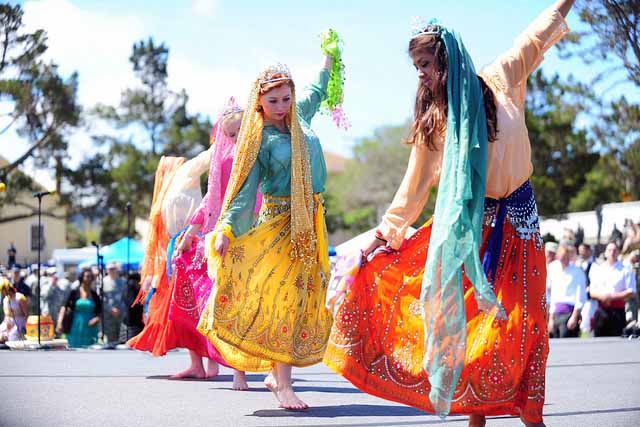
Persian Farsi students perform a Persian dance during Language Day 2014 at the Presidio of Monterey. (Photo by Steven L. Shepard, PoM Public Affairs)
At the Persian Farsi Language School, students embark on a journey of linguistic and cultural discovery guided by highly educated native-speaking instructors. The immersive 64-week program is designed to accelerate fluency and foster a deep understanding of Persian culture and society.
Instructors use innovative educational technology to create interactive, student-centered lessons that are both engaging and effective. This approach supports DLIFLC’s mission to provide an optimal environment for language acquisition and cultural learning.
Beyond the classroom, UPF offers a variety of extracurricular clubs that enrich the student experience, including Ceramics, Persian Music, Movie Club, and a Student Newsletter. These activities encourage creativity, collaboration, and cultural exploration.
Each year, students participate in a special event, showcasing their skills through performances in Persian—songs, dances, and skits that highlight their progress and celebrate the beauty of the language and culture.
The Undergraduate Education Mandarin Chinese School offers a 64-week intensive course that transforms new students into proficient speakers of the most widely spoken language in the world. Both in the classroom and in various other immersive settings, students participate in meaningful discussions on contemporary topics, learning about the rich history of the region – all by doing so exclusively in the target language.
The Chinese Mandarin School’s faculty comprise of highly educated native speakers or near-native speakers who expertly incorporate topics such as regional traditions, pop-culture, music, dress, dance, cuisine, philosophy, history, arts, literature, and military topics into the daily language learning experience. The program boasts a student-centered model of learning. Through innovative teaching approaches and educational technology integration, faculty equip their students with the tools and skills they need to be autonomous learners and prepare them to thrive both in the course as well as in their future military careers.
In addition to classroom instruction, the school further enhances the learning environment by implementing off-campus immersions in a variety of settings, where students are completely immersed in the target language and Chinese culture as they carry out real-life situational scenarios. The school also provides a comprehensive support system by offering advising sessions and language Diagnostic Assessments. Students can meet with a team of language learning specialists and receive individualized learning strategies. The school also offers unique extracurricular clubs such as Tai Chi, calligraphy, debate and a number of music clubs to allow students to dive even deeper into cultural niches – all with the guidance of native-speaking club organizers who are experts on these topics.
The school offers a dynamic learning community committed to academic excellence with its well-established curriculum, high-caliber faculty, and diverse extracurricular activities. If language is a portal to other cultures, then the Chinese Mandarin program is the gateway to that portal, where meaningful connections are made between its accomplished graduates and the 1.3 billion Chinese speakers around the globe with six thousand years of exciting history.
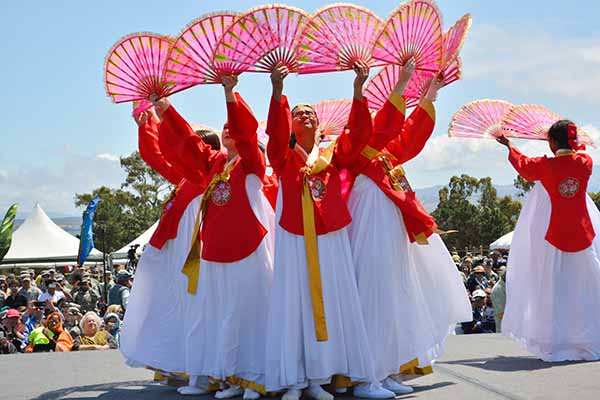
Korean language students perform the Korean Fan Dance at Language Day 2014 on the Presidio of Monterey. (Photo by Gary Harrington)
The Korean Language School offers an intensive 64-week program that cultivates advanced proficiency in Korean while immersing students in the rich cultural heritage of Korea. The curriculum blends rigorous language instruction with deep cultural exploration, ensuring students gain both linguistic fluency and cultural competence.
Native Korean instructors bring exceptional qualifications and a passion for teaching, creating a vibrant classroom environment where language and culture are seamlessly integrated. Students participate in hands-on activities such as cooking traditional dishes, playing cultural games, and engaging in music and dance performances that reflect both historical and modern Korean traditions.
Outside the classroom, students can join one of multiple extracurricular clubs tailored to diverse interests, including K-Drama, North Korea Studies, Calligraphy, Webtoon, and K-Pop. These clubs foster community, creativity, and deeper engagement with the language.
Annual events like the Korean War Speech Contest and the Korean Writing Contest provide students with opportunities to showcase their skills and celebrate their progress. UKP also leverages cutting-edge educational technology to enhance learning outcomes and prepare students for real-world communication.
The Russian Language School at DLIFLC delivers a dynamic 48-week program designed to equip students with the skills needed to communicate effectively in Russian across a wide range of real-life situations. Structured into three semesters, the program offers intensive instruction with five full days of classes each week. Students receive comprehensive preparation for the Defense Language Proficiency Test (DLPT) and Oral Proficiency Interview (OPI), with dedicated support from expert instructors. These educators guide learners through the complexities of Russian grammar, vocabulary, and syntax while fostering a deep appreciation for Russian culture.
Cultural understanding is central to the program. Students explore Russia’s geography, history, traditions, and societal norms, gaining insights into how language and culture shape communication. This cultural literacy enhances students’ ability to engage meaningfully with Russian-speaking communities and prepares them for real-world interactions.