Since 2022, an Air Force mentorship initiative has been quietly revolutionizing how Airmen linguists transition from the foreign language classroom to fully operational linguists.
By focusing on autonomous learning, the 517th Training Group at the Presidio of Monterey, California, has implemented a Global Language Mentorship program that has successfully narrowed a long-standing gap in the Air Force’s second-longest training pipeline.
Historically, the transition for graduates from the Defense Language Institute Foreign Language Center’s academic world to an operational unit was a point of contention. From eight hours of highly intensive instructor-led language learning per day, graduates would find themselves in a self-directed environment at a new duty station.
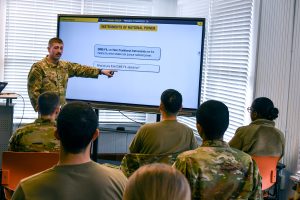
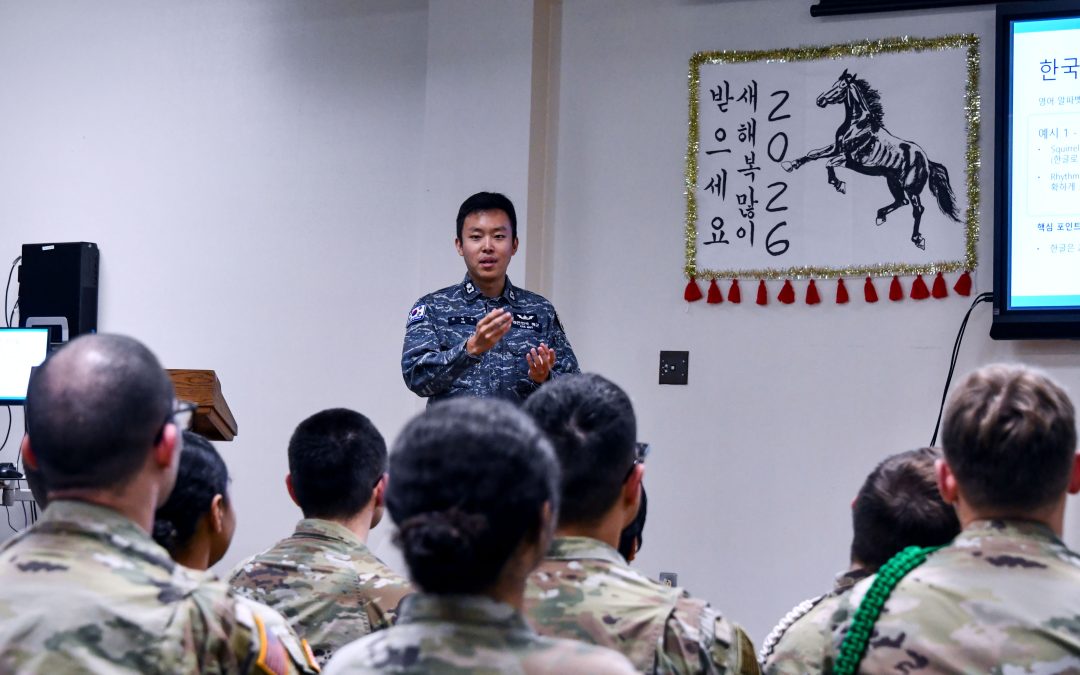
Air Force Tech. Sgt. Michael Stump talks to students attending the two-week Cryptologic Language Analyst Preparatory Course. During the course, mentors introduce the concept of “learner autonomy,” the ability to take 100% ownership of one’s linguistic proficiency.
“They go from a structured academic environment to suddenly being expected to maintain those high-level scores autonomously as adults,” said Tech. Sgt. Michael Stump, noncommissioned officer in charge of the GLM program. Before this program, he explained, they were seeing 18% of graduates fail their first Defense Language Proficiency Test upon arriving at their follow-on duty stations.
In a career field where training can take years and costs millions in taxpayer dollars, an 18% failure rate at the end of the pipeline represented a significant loss of potential.
The GLM program attacks this problem by intervening before the first day of class. While students are in the two-week Cryptologic Language Analyst Preparatory Course, mentors introduce the concept of “learner autonomy,” the ability to take 100% ownership of one’s linguistic proficiency. The course also provides tailored insights into each individual student’s optimal learning styles.
“We reinforce what they learned through the prep course and maintain that motivation throughout the duration of their time at DLI,” Stump said. “We act as an extension of the CPC, meeting with students once a semester.” This mentorship continues on through their follow-on training at Goodfellow Air Force Base, Texas.
By teaching Airmen how to learn—rather than just what to learn—the program ensures that when the safety net of the classroom is removed, the linguist has the tools to stay sharp.
The results of this shift toward early mentorship are significant. Since the GLM program’s inception, the post-graduate DLPT failure rate has dropped from 18% to just 12%, representing a 33% reduction in graduated linguists regressing back below DLIFLC standards after they leave the school.
For the Air Force, those percentage points translate into dozens of additional mission ready linguists staying combat ready every year without the need for costly remedial training.
“We need a source of motivation to tap into. When our discipline may be wavering, we need that ‘why,’” said Master Sgt. Marlyn Williams, flight chief for the CPC and GLM program. “Programs like these ensure our Airmen aren’t just incredibly proficient at their language but that they’re motivated, mission-focused, and ready to defend with professionalism and integrity.”